

 Call us870-805-6039
Call us870-805-6039
Call us870-805-6039
Same breed, two breeding traditions — one bred for the show ring and the family room, one bred for the field. Here's the short version:
| English Lab (show/bench) | American Lab (field) | |
|---|---|---|
| Build | Stocky — deep chest, shorter legs | Leaner, longer-legged |
| Head | Broad, blocky, filled face | Narrower, longer muzzle |
| Coat | Thick double coat | Slightly thinner coat |
| Energy | Moderate — settles indoors | High — bred to work all day |
| Temperament | Calm, steady, eager to please | Driven, intense, athletic |
| Bred for | Conformation and companionship | Hunting and field trials |
| Best fit | Families; therapy and service prospects | Active and sporting homes |
That's the summary. For the full history of how one breed split into two lines — and photos of the two side by side — read our complete comparison: Side-by-Side: English vs. American Labradors →
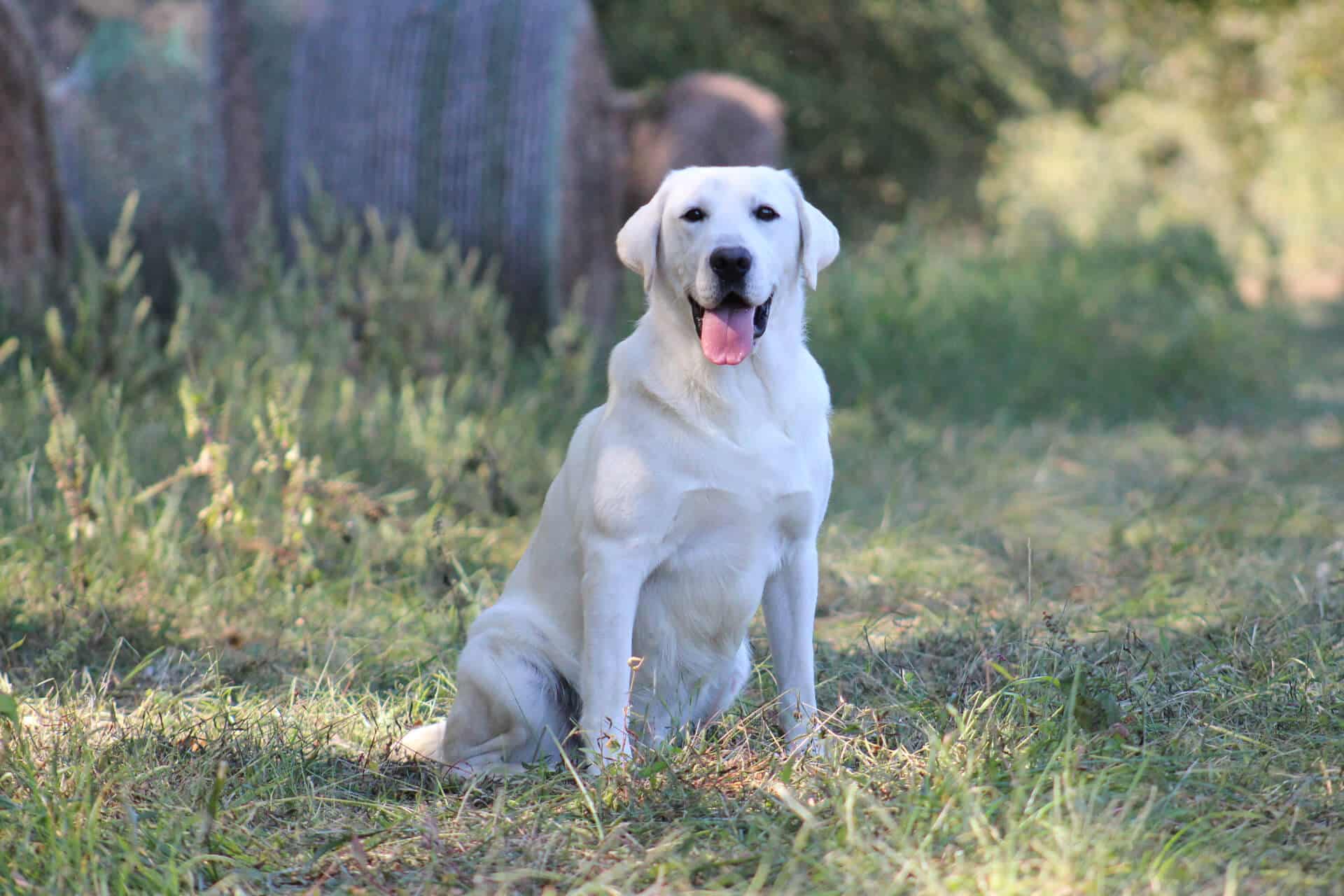
The "English" in English Lab refers to the Kennel Club (UK) conformation standard these lines are bred toward, and it shows in the silhouette. An English Lab is built like a barrel on sturdy legs: a deep, broad chest, a short and powerful body, and a coat thick enough to shrug off cold water. The head is the giveaway — broad and blocky with a well-filled face and a defined stop, where a field-bred Lab's head runs narrower and longer. Behind the dog swings the breed's signature: the otter tail, thick at the base, rounded, and carried level — built as a rudder for swimming.
Adults typically run 60–80 pounds, with our bench-line males usually at the top of that range — around 80 pounds. What they should never be is tall and slight — "stocky, not fat" is the standard's spirit, and keeping an English Lab lean is one of the biggest things an owner controls (more on that under Health).
"English Lab" vs. "British Lab"
You'll see hunting writers compare "British Labs" and "English Labs" as if they're different dogs. They aren't. "British" and "English" both describe the same bench-standard breeding tradition; the words are used interchangeably, and neither is a separate breed or registry category. If a page treats them as two breeds, that's a red flag about the page — not the dog.
The reason most families end up on this page is a word: calmer. English lines were selected for the show ring and the fireside rather than all-day field work, and generations of that selection produced a dog with a working retriever's brain and a house dog's throttle. The phrase we use with visiting families is the "off switch": an English Lab will retrieve, swim, and hike as long as you want — and then settle on the kitchen floor while your household happens around it. Field-bred Labs are wonderful dogs, but many are wired to keep going; the settling has to be trained in. In English lines, you're breeding with the current instead of against it.
That steadiness is why English Labs dominate our program: it's the raw material for family companions, therapy dogs, and service prospects alike. It's also why we can make temperament a selection criterion and not a coin flip — we pair dams and sires with proven calm, steady, people-oriented temperaments, and we watch it show up in litter after litter.
Two honest caveats. First, calm is relative: an English Lab is still a Labrador — a sporting breed that needs real daily exercise and a job for its brain, especially in the first two years. Second, no line guarantees an individual puppy's personality; breeding stacks the odds, raising and training close the deal. That's exactly why every puppy we place goes home with structured training already underway.
The AKC recognizes three Labrador colors: black, chocolate, and yellow. English lines come in all three, but they're best known for the pale end of yellow — the cream-to-white coats most people picture when they hear "English Lab."
Here's the part worth getting right: a white Lab is a yellow Lab. "Yellow" is a spectrum that runs from deep fox red to a coat so pale it reads as white, and a white Lab sits at the palest end of that spectrum — same dark nose, eye rims, and paw pads, and its registration papers say yellow. White is not a separate breed, it isn't albinism, and it isn't rare: pale parents predictably produce pale puppies. A breeder charging a "rare white Lab" premium is charging you for a word. Our own pricing tracks documented training and health testing — it does not track coat color, and there is no premium for shade.
The full genetics — the E locus, intensity genes, and how to spot color-first marketing — are in our guide: White Lab vs. Yellow Lab →
A healthy English Lab lives 11 to 13 years on average. The two biggest levers are the ones you'd guess: genetics and weight. Labs love food; lean dogs live measurably longer, so feeding discipline is the cheapest longevity program there is.
The genetic lever belongs to the breeder, and it's testable. The conditions that shorten Labrador lives and mobility — hip and elbow dysplasia, inherited heart and eye disease, and DNA-detectable conditions like exercise-induced collapse (EIC), progressive retinal atrophy (PRA-prcd), and centronuclear myopathy (CNM) — are screened for before a responsible program ever breeds a dog.
Every claim above is checkable on this site
Before any dog joins our breeding program, it's independently screened — OFA X-rays and specialist exams for hips, elbows, heart, and eyes, plus an Embark DNA panel covering 190+ genetic health markers — the exact panel varies by breed and dog, and Embark adds new markers regularly. We publish the original certificates for each of our 35+ parent dogs — not summaries — so you can verify every result yourself, and OFA results are independently searchable in OFA's public database. Every puppy is backed by our 5-year genetic guarantee, one of the longest in the US.
An English Lab is a strong fit if:
Think twice if:
Honest fit matters more to us than a deposit — it's why we match puppies to families rather than selling first-come, first-served.
Three ways in, depending on how much of the puppy stage you want to handle yourself — and one rule that applies everywhere you shop.
Pick a puppy from a litter
Our English Lab litters are posted with photos of both parents, their health certificates, and expected go-home dates. Every puppy goes home with Wagology training underway — from foundation obedience to fully finished — and every family follows their puppy's progress week by week in our customer portal.
Bring home a trained dog
If you want the puppy stage handled — house routines, obedience, socialization already documented hour by hour — our trained dogs go home at the level of finish you choose, from $7,500 by training level.
Vet any breeder like a pro
Wherever you buy — including here — demand the same things: health testing on both parents you can verify, temperament records, access to the dam and sire, and a written guarantee. We published the full checklist, plus the red flags that should end a conversation.
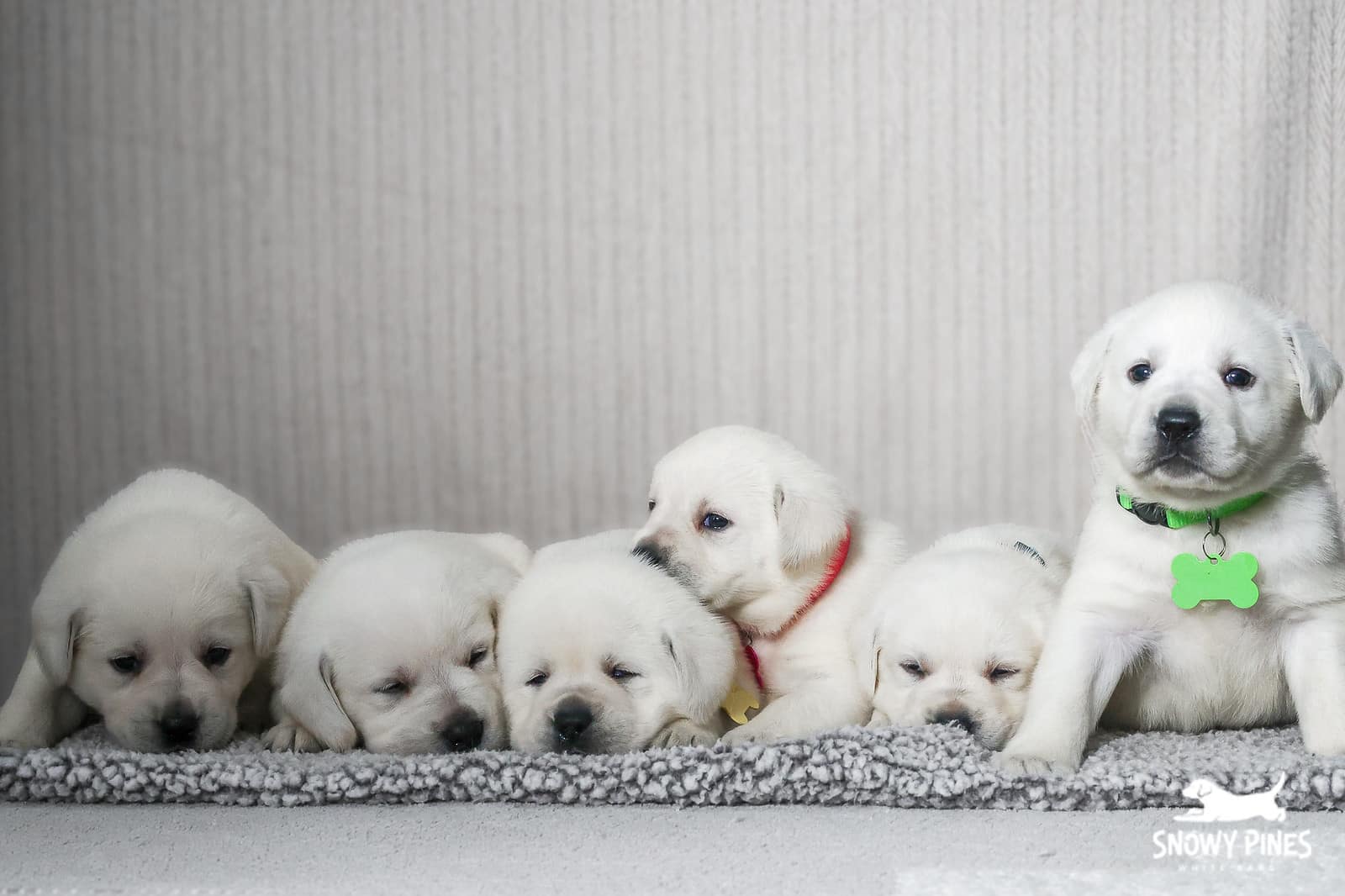
Current English Lab litters at Snowy Pines — these update automatically as litters post and reserve, and every card links to the litter listings with both parents’ health certificates.
Everything above is theory until you meet the dogs. Come visit us in Batesville, walk the facility, meet the parent dogs, and read every certificate before you decide anything — or start with the litters and their health-tested parents online.
Written by the Snowy Pines team · reviewed by our AKC-approved CGC evaluators. · Updated August 2026






 Wagology 101 completes: November 20, 2026